Monogram E: A Designer’s Honest Embroidery Review
Whenever I pull a new monogram design into my digital library, I immediately picture it on a finished product. Not a flat screen rendering, but something that a customer might hold, gift, or wear. When I opened Monogram E for the first time, my mind jumped straight to a linen tote bag I’ve been meaning to stitch up for a bridesmaid order. The design sat in front of me—floral, ornate, and deeply classic—and I immediately started asking the practical questions I always ask before a single stitch hits fabric. Will it sew cleanly on textured linen? Is the scale right for a prominent monogram, or will it feel too delicate for the job? And, most importantly, will it look like something someone paid real money for?
First Impressions: Floral, Feminine, and Extremely Versatile
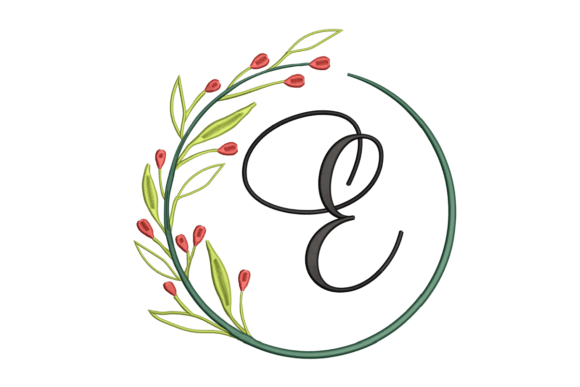
Right away, Monogram E delivers a soft, garden-inspired mood. The letterform itself is beautifully integrated with leaf and petal elements that swirl outward without ever overpowering the central E. I’ve tested dozens of floral monograms over the years, and the balance here is what I’d call “graceful but grounded.” The stems and blossoms feel intentional—not just scattered decals, but a real design thought-through for thread work. Even without sample sew-out, the visual density suggests strong satin stitch segments combined with light fill stitch areas and delicate running stitch connections. That blend usually tells me the digitizer understood how fabric behaves under tension.
What immediately sets this apart is its adaptability. The mood can shift from romantic to rustic simply by swapping thread colors. In a deep burgundy on cream canvas, it reads vintage. In a matte sage green on natural linen, it softens into modern farmhouse. That kind of flexibility means I could use Monogram E across a wide range of products without ever feeling stale.
Where Monogram E Shines in Real Projects
I don’t trust a design until I picture it through the lens of specific, sellable goods. Here’s where this floral E feels like a natural fit—and where I’d confidently use it in my own small shop work.
Apparel That Feels Handmade, Not Mass-Produced
For lightweight sweaters, linen button-downs, and baby apparel, Monogram E adds a personal touch without tipping into overdone. On a white cotton onesie, stitched in soft peach or lavender, it turns a plain garment into a baby shower gift that photographs beautifully. The floral details give it the kind of premium look that lets Etsy sellers command a higher price point. For adult wear, I’d lean toward crewneck placement on a French terry sweatshirt. The design’s open curves allow the fabric to keep its drape, so you’re not dealing with that stiff patch feeling some dense monograms create.
Home Decor Touches That Buyers Notice
Tea towels and pillow covers are where this design really earns its keep. A simple linen kitchen towel with Monogram E in a tonal thread (think oatmeal fabric with off-white stitching) becomes a thoughtful hostess gift or a bridal shower bestseller. The embroidery file seems to include enough airy negative space that the stitches won’t warp the towel’s weave when you use a medium-weight cutaway stabilizer. On a 20-inch pillow cover, placed off-center or in a corner, the monogram reads as tailored boutique styling—exactly the kind of product that stops a craft fair browser mid-stride.
Giftable Items That Feel High-End
I’m already planning a batch of quilted makeup bags with this E as the starring element. Combine it with a matching ribbon zipper pull, and you’ve got a bridesmaid proposal gift that hits far above its production cost. Because the letter sits prominently in the center, the whole piece feels intentional. The floral backbone of the design means you don’t need extra embellishment—just the monogram does all the heavy lifting. That’s the mark of a strong machine embroidery design: it simplifies your production while amplifying perceived value.
Thinking Through Fabric and Hoop Size Challenges
No design works everywhere, and I always look for the edges of a design’s performance envelope. With Monogram E, the delicate floral extensions warrant attention on two fronts: fabric texture and hoop size. On highly textured linen or slubbed cotton, some of the thinnest running stitch tendrils might sink in and lose definition. I’d test a scrap with a topper to see if the stitches lay on the surface cleanly. If you’re working on dark fabric, contrast becomes non-negotiable—a pale gold or ivory thread can make the details pop, but a darker thread on a dark ground will likely swallow the smaller leaf veins.
Regarding hoop size, the design’s sweeping shape suggests it needs breathing room. If scaled too tightly—say, crammed into a 4x4 hoop for a baby cap—you risk closing up those elegant inner loops and turning the floral work into a blurry mass. I’d only use this on a small hoop if the digitizing allowed a reduced stitch count variant, which isn’t something I can confirm without the specific file. So, treat small caps, curved visors, and tightly structured bags with caution. The monogram naturally thrives on flat or moderately curved surfaces where the hoop can hold tension evenly.
Stretchy fabrics like jersey or ribbed knit also call for extra steps. I’d use a fusible mesh stabilizer, float the garment carefully, and maybe add a light spray adhesive to keep the knit from shifting. The satin stitch portions should still be dense enough to read clearly, but I’d slow my machine speed slightly to avoid puckering. Again, a thorough test sew on similar fabric will save you from ruined blanks.
How This Design Lifts Product Value and Brand Perception
From a business standpoint, Monogram E does something wonderfully smart: it makes your handmade product look curated. When a customer sees a floral monogram on a tote bag or a baby blanket, they don’t just see stitching—they see a deliberate design choice. That lifts the entire product out of “craft” territory and into “boutique.” For Etsy sellers, a well-stitched monogram in listing photos signals trust. Buyers understand that a monogram takes skill, and they’re more likely to pay a premium for personalized items.
Consistency is also key. The design’s symmetrical but organic layout means you can carry the same floral letter E across multiple products—a blanket, a bib, a memory book cover—and build a mini collection that reinforces your small shop brand. In my own experience, cohesive product photography with repeated monogram styling often leads to higher basket totals and repeat buyers.
Practical Designer Notes: My Personal Checklist
Before you load Monogram E into your machine’s memory, I’d run through a few non-negotiable checks that every working embroiderer needs to consider:
- Stitch a test on scrap fabric first. Even the best-looking digital embroidery file can behave unexpectedly on a new substrate. Watch thread tension, trims, and small detail clarity.
- Check thread color contrast on both light and dark backgrounds. A design that looks stunning in a digital mockup can disappear on navy canvas. Do a quick black-and-white preview to gauge value contrast if you can.
- Review stitch density and order. If you own editing software, peek at the sequence. Dense central elements layered over delicate running stitch tendrils can cause pulling if not ordered well.
- Confirm hoop size compatibility. The listing mentions multiple embroidery file formats, but you’ll want to measure the exact stitch area and ensure it fits your largest comfortable hoop—not just your machine’s maximum.
- Use the right stabilizer. My default for something like this is a medium cutaway on wovens, or a no-show mesh on knits. Don’t rely on tear-away for garments that will get washed often.
- Inspect small details after washing. If you plan to sell machine-washable items, launder your test piece exactly as a customer would. Fine satin stitches can fray if they’re not properly locked.
- Verify licensing for commercial use. The product page states it includes multiple file formats, but always double-check whether the seller permits use on finished items for resale. This is especially important if you sell physical products or include the design in digital design asset bundles.
Final Take: A Monogram That Does the Heavy Lifting
After dissecting every practical angle, Monogram E lands solidly in the “use with confidence” category for anyone creating personalized gifts, custom apparel, or boutique home decor. It’s not a design that demands you build an entire project around it; it simply elevates whatever you attach it to. The floral construction feels fresh without being trendy, and the letterform remains unmistakably clear—something I’ve seen plenty of overly decorative monograms fail to achieve.
For craft business owners, this is the kind of machine embroidery design you can keep on rotation for years. It works beautifully on tote bags, baby items, tea towels, pillows, and more. If I had one small piece of advice: before your first customer order, sit down with a cup of tea, stitch it out on a sample, and watch how the thread blooms. You’ll immediately know which thread palettes and bases will become your staples. From there, Monogram E will quietly become one of those dependable Shapes in your library—an Embroidery asset that brings elegance and real product value to every project it touches.